Chef Continuous Line: A Designer’s Real-World Embroidery Review
First Impression: Clean, Warm, and Quietly Confident
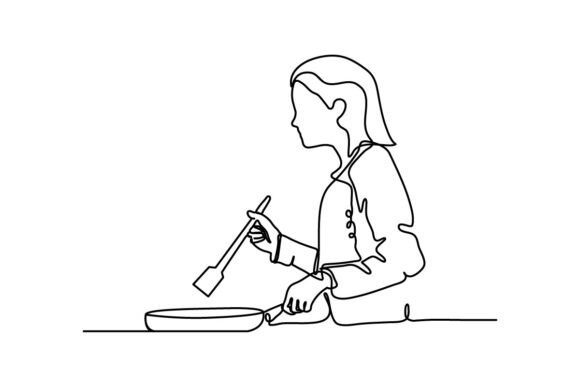
When I opened Chef Continuous Line for the first time, I didn’t see “just another kitchen motif.” I saw a quiet moment — mom at the stove, rendered in one unbroken line. No shading, no outlines, no fuss. Just confident, flowing vector rhythm on white. It’s minimalist, yes — but not sterile. There’s warmth in the curve of her arm holding a spoon, the tilt of her head, the subtle suggestion of steam rising from a pot. This isn’t clipart. It’s an illustration with breath.
A Real Project Test: Embroidering a Linen Kitchen Towel
Last week, I used Chef Continuous Line to embroider a set of linen tea towels for a local boutique. The client wanted something heartfelt but refined — no cutesy fonts or cartoon flames. Just real, grounded, handmade energy. We stitched it in soft ecru thread on natural undyed linen, using a medium-weight cutaway stabilizer. The result? Calm, elegant, instantly legible at 3.5 inches wide. Customers paused mid-aisle. Not because it shouted — but because it settled the eye. That’s the power of intentional minimalism in embroidery.
Where Chef Continuous Line Shines (and Where It Asks for Care)
This design thrives where subtlety matters: custom apparel for food bloggers, embroidered patches for chef school grads, baby onesies for culinary families, or pillow covers for cozy farmhouse kitchens. Its single-line nature means low stitch density — ideal for lightweight cotton, rayon blends, and even delicate chambray. On a sweatshirt? Use a tear-away + light cutaway combo and keep hoop tension even — the clean curves hold up beautifully without puckering.
But here’s what I watched closely: corners and tight turns. Because it’s continuous line art, the needle path loops back on itself in places — like the wrist bend or the pot handle. On textured fabrics (think terry cloth towels or bouclé aprons), those small directional shifts can catch if your machine’s tension is off or your stabilizer isn’t fully bonded. Always test on scrap first — especially if you’re stitching on stretchy knit baby bodysuits or curved cap fronts.
Dark fabric? Chef Continuous Line works — but only with high-contrast thread (navy on cream, charcoal on oat). Avoid matching thread on black; the design relies on contour, not fill. And skip ultra-thin fabrics like voile unless you add a backing layer — the line weight is delicate enough that it can “float” or distort without proper support.
What It Adds to Your Finished Product — Beyond Looks
Embroidery isn’t just decoration. It’s trust. When a customer sees Chef Continuous Line on a personalized gift — say, a tote bag for Mother’s Day — they don’t just register “mom cooking.” They feel intention. Craft. Quiet pride. That lifts perceived value. Etsy sellers tell me listings with this design get more saves and longer dwell time — likely because it reads as *designed*, not downloaded.
For small shop owners building brand consistency, Chef Continuous Line plays well with neutral palettes and hand-drawn typography. Pair it with a simple sans-serif monogram on the same towel, and you’ve got cohesive, scalable design assets — no overcomplicating needed. It also scales cleanly: at 2 inches for a cap front, it reads as a charming accent; at 5 inches on a pillow cover, it becomes a gentle focal point.
Design Notes Every Embroiderer Should Check Before Stitching
- Test on scrap fabric first — especially with your exact stabilizer + thread combo. Linen behaves differently than cotton poplin.
- Review stitch density in your software — even though it’s a line design, some vector-to-embroidery conversions add unnecessary underlay. Trim it if needed.
- Confirm hoop size compatibility — the file includes EPS, SVG, and JPG, but you’ll need to digitize or convert for your machine. Make sure your digitizer preserves the fluidity.
- Inspect small details — zoom in on the spoon tip and pot spout. Are they crisp? Do they translate cleanly to running stitch?
- Try black-and-white mockups — does the shape hold up when stripped of color context? (It does — that’s a sign of strong graphic structure.)
- Compare light vs. dark fabric backgrounds — contrast is your friend here. Don’t assume white thread will read clearly on ivory.
- Use proper stabilizer — lightweight cutaway for stable wovens; tear-away + topping for napped or fuzzy surfaces.
- Verify licensing — since Chef Continuous Line is sold as a Graphics file, confirm whether commercial use (e.g., selling finished embroidered totes) is permitted before listing on Etsy or at craft fairs.
Who It’s Really For — And Who Might Want to Think Twice
If you’re an embroidery designer creating custom nursery decor, a craft business owner launching a “Mom’s Kitchen” product line, or an Etsy seller curating thoughtful holiday embroidery files — Chef Continuous Line fits like a well-worn apron. It supports storytelling without clutter. It invites personalization (add a name below the pot, or swap the spoon for a whisk) without breaking its visual grammar.
But if you need dense fill-stitch texture, photorealistic detail, or lettering built into the design — this isn’t it. It’s not an applique design. It’s not a satin-stitch monogram. It’s a continuous line — pure and purposeful. Respect that. Lean into it.
Final Thought: Less Is Anchored, Not Empty
In a world of busy embroidery files — layered, glittered, over-digitized — Chef Continuous Line reminds me why I started designing in the first place: to make things that land softly but stay remembered. It won’t dominate a garment. It won’t scream for attention. But when stitched right, on the right fabric, for the right person? It feels like a quiet nod — warm, human, and unmistakably handmade.