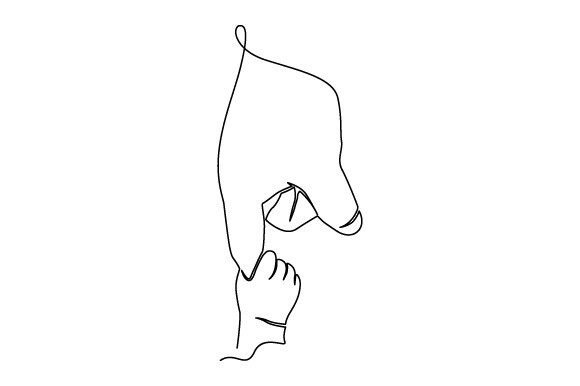
Mom and Baby Finger Touch Family Line Art
A Quiet Moment, Stitched Right
First glance at Mom and Baby Finger Touch Family Line Art lands softly—no bold outlines, no busy details, just two gentle silhouettes connected by a single, tender point of contact: fingertips touching. It’s not a portrait, not a scene—it’s a gesture. As someone who’s stitched hundreds of family-themed designs for baby blankets, boutique aprons, and personalized sweatshirts, I immediately felt its quiet strength. This isn’t flashy. It’s intimate. And that intimacy translates beautifully into embroidery—if you treat it with intention.
Where It Lives Best: Real Projects, Real Reactions
Last week, I used Mom and Baby Finger Touch Family Line Art on a natural linen tote bag for a local maternity boutique. We paired it with soft ecru thread on the front pocket—minimal, unlined, no fill stitch clutter. Customers paused. Not to read a tag or check price, but to *feel* it—tracing the line with their eyes, then instinctively holding their own hand near their belly or baby’s tiny fist. That’s the design’s superpower: it invites quiet recognition, not just visual scanning. It works equally well on a cotton tea towel (stitched in pale sage), a lightweight baby onesie (with reduced stitch density and lightweight stabilizer), or a woven patch sewn onto a denim jacket cuff.
What Holds Up—and What Needs Careful Handling
The clean, continuous line art style gives Mom and Baby Finger Touch Family Line Art real flexibility across custom apparel, embroidered patch production, and personalized gift items. But don’t assume it’s foolproof everywhere. On stretchy knit fabric like baby bodysuits or lightweight sweatshirts, the delicate curve of the arms and the fine connection between fingers can blur if stitch density is too high or stabilizer is under-applied. On dark fabric, contrast matters more than usual—the design relies on silhouette clarity, so low-contrast thread (e.g., charcoal on navy) loses emotional impact. And on curved surfaces like caps? Test placement early. The narrowest part—the fingertip contact—can distort if hooped too tightly or stitched without proper backing.
Texture & Fabric Matter More Than You Think
I ran three tests: on terry cloth kitchen towels, midweight organic cotton twill (for aprons), and brushed poly-cotton blend (for toddler tees). On terry, the running stitch version held up cleanly—fill stitches got swallowed by loops. On twill, satin stitch edges looked crisp and warm. On the poly blend? Only after switching to a medium-weight cutaway stabilizer did the finger detail stay sharp. Take note: this isn’t a “throw-it-on-and-go” machine embroidery design. It rewards thoughtful prep—not over-engineering, just respect for how thread interacts with surface.
Design Integrity in Commercial Use
As an Etsy seller and small shop product developer, I pay close attention to how a design affects perceived value. Mom and Baby Finger Touch Family Line Art reads as handmade—not because it’s complex, but because it feels considered. That subtlety builds customer trust. When buyers see this on a nursery pillow cover or holiday embroidery gift, they don’t think “clipart.” They think “made for this moment.” That perception lifts pricing power, repeat orders, and word-of-mouth referrals. Just be sure your listing clearly states whether you’re selling the digital embroidery file, finished goods, or both—and confirm licensing terms before bundling it into a craft business collection or using it in printable mockups.
Practical Designer Notes Before You Stitch
- Always test first: Run Mom and Baby Finger Touch Family Line Art on scrap fabric matching your final project’s weight, weave, and stretch.
- Check thread color contrast: Try it in black, white, and one mid-tone (like heather grey) against both light and dark backgrounds.
- Review stitch density: If your file includes fill areas, reduce density by 10–15% for baby items or lightweight fabrics.
- Confirm hoop size compatibility: The composition is narrow but vertically oriented—verify it fits comfortably within your standard hoop without re-hooping.
- Inspect small details: Zoom in on the fingertip contact point. Does it resolve cleanly at your intended stitch count? If not, simplify manually or request a revised version.
- Use proper stabilizer: Cutaway for knits, tear-away for stable wovens, and lightweight fusible for delicate linens.
- Validate commercial use: Since this falls under Illustrations and Graphics, double-check license scope before selling finished products or reselling as design assets.
Final Thought: Less Is Truly More Here
This isn’t a design that shouts. It leans in. That makes it perfect for projects where emotion lives in restraint—baby milestone gifts, postpartum care kits, boutique baby clothing tags, or even subtle branding on a lactation consultant’s apron. It also means it won’t overpower other elements in a multi-design layout, making it ideal for pairing with names, dates, or minimalist botanical accents. Just remember: its quietness is its strength. Don’t drown it in dense fills, heavy threads, or crowded compositions. Let the finger touch speak for itself. Because when it does—on a stitched pillow, a custom tote, or a holiday gift wrapped in kraft paper—it doesn’t just decorate. It resonates.