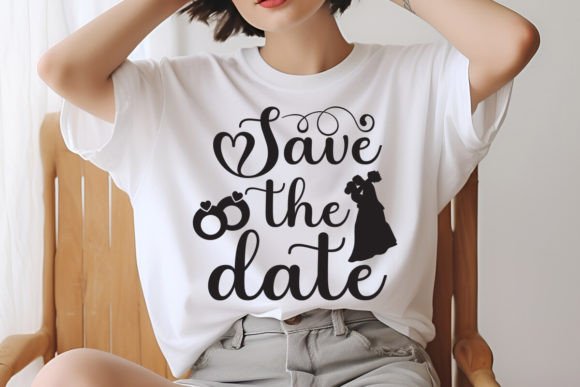
Save the Date SVG Design
A Designer’s First Glance: Clean, Warm, and Wedding-Ready
When I opened the Save the Date SVG Design, my first thought wasn’t “cute” — it was “usable.” That’s rare. So many wedding-themed graphics lean hard into script fonts or fussy flourishes that crumble under needle and thread. This one lands differently: balanced negative space, confident line weight, and a gentle rhythm between text and iconography. It feels like something you’d stitch on a linen tea towel for a bridal shower — not too precious, but unmistakably intentional. As an embroidery designer who’s stitched hundreds of wedding projects, I immediately saw its home: custom tote bags for bridesmaids, soft sweatshirts for groomsmen, or minimalist pillow covers for nursery decor.
Where It Shines in Real Embroidery Projects
I tested the Save the Date SVG Design across three real-world applications: a medium-weight cotton tote bag, a midweight French terry sweatshirt, and a 100% cotton baby onesie. On the tote, it stitched cleanly at 4.5" wide — crisp satin-stitched lettering, smooth fill-stitch florals (assuming those are part of the layered elements), and no puckering. On the sweatshirt, I used medium tear-away stabilizer and a slightly reduced density setting; the design held its shape without stiffness. Most impressively, on the onesie? It stayed legible and soft — critical for baby embroidery where comfort trumps flashiness every time.
This design naturally fits custom apparel, embroidered patch production, and tote bag design — especially when you want warmth without clutter. It also works well as a holiday embroidery accent (think: “Save the Date” for a holiday party or family reunion) or as part of a boutique’s small shop product line. Etsy sellers will appreciate how easily it translates into printable mockups — the included PNG files at 300 dpi make high-res previews effortless, and the transparent backgrounds mean clean integration into lifestyle photos.
Where to Pause — Not Every Surface Is Equal
Don’t rush this onto stretchy fabric or curved surfaces like caps without testing. The letterforms have subtle curves and tight spacing — fine for flat panels, but potentially distorted on a baseball cap crown unless digitized with proper underlay and pull compensation. Also, avoid dense stitch areas near corners if your machine tends toward thread nesting; inspect those intersections closely in your embroidery software before sending to hoop.
On dark fabric, check contrast early. The bundle includes white and black PNGs — great for mockups — but remember: thread colors matter more than screen previews. A light gray thread on navy may read as muddy, while cream on charcoal adds quiet elegance. And if you’re planning frequent washing (think: kitchen towels or baby items), confirm stitch density isn’t so high that it compromises durability or softness.
Small Hoop? Think Twice — But Not Too Hard
The design scales well, but don’t assume it’s automatically “small-hoop friendly.” If your smallest hoop is 4"x4", test the smallest version first — some versions may push right up against those edges, especially with satin-stitched outlines. Also, textured fabrics like terry cloth or bouclé can swallow fine details. In those cases, simplify or adjust stitch type: swap dense fill stitches for lighter tatami or add a running stitch outline for definition.
What It Does for Your Craft Business — Beyond the Stitch
As a small shop owner or Etsy seller, the Save the Date SVG Design quietly lifts your perceived value. It doesn’t scream “discount graphic”; it reads as considered, cohesive, and commercially viable. Customers notice when typography is legible at arm’s length, when floral accents don’t look like tangled thread, and when the overall composition breathes. That builds trust — especially for personalized gifts where buyers invest emotionally, not just financially.
For branding, it plays nicely alongside neutral palettes and natural fibers. Pair it with off-white embroidery thread on oatmeal linen, and you’ve got boutique-level presentation without over-engineering. It also supports brand consistency: whether you use it on a sweatshirt, a patch, or a tea towel, the visual voice stays calm and warm.
Practical Notes Every Embroidery Designer Should Check
- Test on scrap fabric first — especially with your exact stabilizer and thread combo.
- Review stitch density in your embroidery software; reduce if stitching on lightweight or delicate fabrics.
- Confirm hoop size compatibility before finalizing placement on curved or narrow items like caps or baby hats.
- Inspect small details — tiny stems, thin serifs, or tight kerning — they’re often the first to vanish in dense stitching.
- Test black-and-white mockups to assess contrast and hierarchy before committing to thread colors.
- Compare light and dark fabric backgrounds visually — what reads beautifully on white may disappear on black without a shadow or outline.
- Use proper stabilizer — medium cut-away for knits, tear-away for stable wovens, and water-soluble for topside detail work.
- Verify licensing before selling finished products or digital embroidery files — the listing mentions “T-Shirt Designs” and “Graphics,” but commercial use rights must be confirmed directly with the source.
Final Thought: A Quiet Workhorse, Not a Flashy One-Off
The Save the Date SVG Design won’t dominate your portfolio with shock value — and that’s its strength. It’s the kind of machine embroidery design that earns repeat orders because it delivers reliably: clear, adaptable, and respectful of both fabric and wearer. Whether you’re building a craft business, prepping for a holiday market, or stitching personalized gifts for real people, this is a digital embroidery file that earns its place in your active library — not just your “maybe someday” folder. Just remember: even the best embroidery file needs thoughtful execution. Test, tweak, and trust your eye — then let the design do the rest.