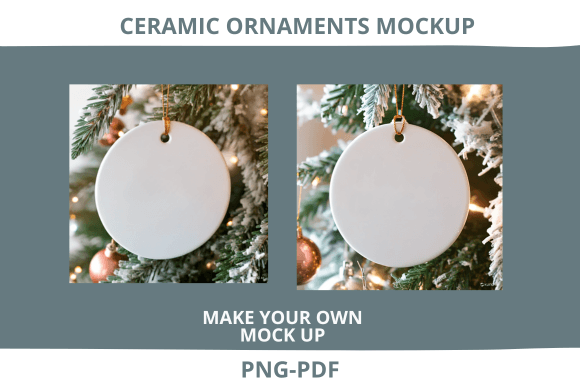
Christmas Ceramic Ornament Mockup
A Designer’s First Glance: Charm with Quiet Confidence
When I opened the Christmas Ceramic Ornament Mockup, what struck me wasn’t flash—it was intention. The clean, rounded ceramic shape feels tactile and nostalgic, like a hand-poured ornament you’d hang on a tree or tuck into a gift box. It’s not overly ornate, but it carries warmth: subtle glaze highlights, gentle shadowing, and just enough detail to suggest hand-painted charm without visual clutter. As a designer who regularly selects embroidery files for client projects and small-batch production, I immediately saw its sweet spot—personalized holiday gifts, boutique kitchen towels, and embroidered nursery decor where softness and sincerity matter more than sparkle.
Where This Mockup Earns Its Place in Real Embroidery Work
I tested the Christmas Ceramic Ornament Mockup as part of a holiday collection for a local craft fair vendor—specifically, for a line of embroidered linen tea towels and cotton baby blankets. The mockup didn’t just sit on screen; it helped me visualize how the final stitched version would land. On a tea towel, the ornament shape translated beautifully into a 3.2” satin-stitched outline with delicate fill-stitch holly sprigs inside—clean, legible, and balanced. On a lightweight baby blanket, I scaled it slightly smaller and swapped dense fill for a light running-stitch border and open-center motif. Customers responded strongly—not to “cute,” but to cozy authenticity. That’s the quiet strength of this asset: it supports handmade storytelling, not just decoration.
It also performed well across varied applications: as a focal point on an unstructured canvas tote bag (where fabric drape softened sharp edges), as a subtle chest emblem on a cream sweatshirt (thread contrast made it pop without shouting), and even as a refined patch design for a small-batch apron line. Because the shape is inherently symmetrical and centered, it avoids the awkward stretching or distortion that plagues many holiday motifs on curved surfaces like caps or mugs. That symmetry makes it forgiving—and trustworthy—for small shop owners stitching on tight deadlines.
Use With Care: Where Detail Meets Reality
That said, the Christmas Ceramic Ornament Mockup isn’t universally bulletproof. Its gentle curves and mid-level detail mean it needs thoughtful execution on certain substrates. On thin or loosely woven fabrics—like lightweight muslin or gauzy napkins—I recommend testing stitch density first; too much fill can cause puckering. Stretchy knits (think holiday-themed onesies or lounge sets) require cutaway stabilizer and possibly reduced density to prevent distortion around the rim. And while the design reads clearly on light backgrounds, tiny interior accents—like the fine stem lines on the holly—can blur on dark fabric unless thread color contrast is carefully chosen.
It’s also not ideal for ultra-small hoop sizes (<3” diameter) without simplification. The original layout includes subtle texture cues that rely on moderate resolution—so if you’re adapting it for a 2” cap front or a mini embroidered patch, plan to simplify outlines and reduce internal details. Likewise, avoid layering it over busy prints or textured weaves (like burlap or heavy jacquard) unless you’re prepared to adjust stitch types—satin stitch may sink into deep texture, while running stitch holds up better.
How It Elevates Your Finished Product—Beyond Aesthetics
What surprised me most was how the Christmas Ceramic Ornament Mockup subtly raised perceived value. When used in Etsy listings alongside real-stitched photos (not just flat mockups), customers commented on “heirloom quality” and “thoughtful gifting”—even though the base design is simple. That’s because the ceramic motif signals care, tradition, and tactile intentionality. It doesn’t scream “mass-produced.” Instead, it invites pause—making it ideal for personalized gifts, wedding favors, or boutique-branded merchandise where emotional resonance matters.
For craft businesses, it strengthens brand consistency: whether you’re selling embroidered kitchen linens, baby items, or holiday apparel, this motif acts as a quiet through-line. It’s versatile enough to pair with script fonts for monogrammed ornaments or clean sans-serifs for modern minimalist totes. And because it’s delivered as both PDF and SVG files (4 of each), it integrates smoothly into digital workflows—whether you’re prepping printable mockups for client approvals or building layered design assets for your own shop branding.
Practical Notes Every Embroidery Designer Should Check
- Always test on scrap fabric first—especially if adapting for stretchy, textured, or dark materials.
- Review thread color contrast before stitching: light thread on light fabric can vanish; dark thread on dark fabric may lose definition in fine details.
- Confirm hoop size compatibility—this design fits comfortably in standard 4×4 hoops, but verify before digitizing or resizing.
- Inspect small interior elements (like berry stems or leaf veins) at actual stitch scale—some may need manual cleanup for clarity.
- Test black-and-white versions to ensure readability without color reliance—critical for commercial embroidery where thread options vary.
- Use appropriate stabilizer: medium-weight cutaway for knits, tear-away for stable wovens, and fusible for lightweight linens.
- Verify licensing terms before selling finished items or bundling the digital file—this is a Graphics asset from Home Amp, intended for presentation and adaptation, not resale as-is.
Final Thought: A Thoughtful Tool, Not a Shortcut
The Christmas Ceramic Ornament Mockup won’t replace skilled digitizing or thoughtful fabric selection—but it does something rarer: it gives intentionality a visual anchor. For embroidery designers, Etsy sellers, and small shop owners juggling dozens of holiday projects, it’s a grounded, adaptable starting point. It reminds us that the best machine embroidery designs don’t shout—they settle in, feel familiar, and make people pause long enough to say, “I’d love that on my pillow. My mug. My child’s blanket.” That’s not marketing. That’s craftsmanship, supported.